informatii

vineri, 10 decembrie 2010

Retete de craciun din carne de porc(sunca afumata carnati afumati toba de casa caltabosi etc)

Saramurarea si Afumarea Suncilor
slanina se face asa :

La 1 litru de apa punem urmatoarele cantitati :
150 gr sare
3 foaie de dafin
1 lingurita piper macinat
5-10 buc piper boabe
1 lingurita cimbru (sau o crenguta mai mica)
1/2 capatana de usturoi

Apa o punem sa dea intr-un singur clocot, adaugam sarea,piperul macinat , dafinul,piperul boabe si cimbrul. Usturoiul se zdrobeste cu lama cutitului si se adauga la saramura.Se lasa la racit si se toarna peste sunca,ciolane si slanina cat sa fie acoperite.Se pune deasupra un fund de lemn si o greutate sa fie presate si se pune la un loc racoros si din 3 in 3 zile intoarcem bucatile de carne.
Slanina o punem separat in saramura. Saramura lichida ptr. sunca (pulpa din spate a porcului),ciolane si

Sunca(pulpa) se tine in saramura 30-35 de zile
Ciolanul se tine 21 zile
Slanina 21 zile

Dupa ce bucatile au stat suficient in saramura, se scot si se clatesc in apa rece, se sterg cu un prosop uscat si se pun la zvantat intr-un loc bine aerisit timp de 10- 15 ore. Se pun apoi la afumat unde se tine pana prinde o culoare roscata.

Slanina se tine la afumat pana primeste o culoare rosiatica - galbuie cca 3-4 zile, dar trebuie avut grija ca fumul sa nu fie cald.

Fumul cel mai bun este cel obtinut prin arderea lujerilor de porumb sau din rumegus. La tara se mai foloseste ptr afumat ramuri de vita de vie, se spune ca este cel mai bun fum.


Roxi , in cazul tau in loc de 150 gr sare la 1 l de apa vei pune 200 gr sare tinand cont ca la voi temperatura este mai mare decat la noi acum.
Fumul cel mai bun, care dă gust plăcut cărnii, este cel din coceni de porumb.

Un mijloc uşor şi practic pentru afumat este un butoi fără fund. În locul fundului se aşază un lighean sau un alt vas mai mare. Pe fundul ligheanului se aşterne un strat gros de

cenuşă, peste cenuşă jeratic (cărbuni aprinşi), iar peste jeratic un rînd de coceni umeziţi. Bucăţile de slănină, carne sau cîrnaţi se atîrnă pe beţe, iar neţele se sprijină de marginile butoiului, astfel încît slănina, carnea etc să se afle în interiorul butoiului. Se acoperă butoiul cu cîteva ziare, peste care se pune un sac în aşa fel ca fumul să nu iasă afară.

În 4–5 ore carnea este afumată şi capătă o culoare frumoasă ruginie. Cîrnaţii şi slănina se afumă mai repede.

În tot timpul afumării, la interval de 15–20 min, se ridică puţin sacul pentru a controla dacă nu cumva s-au aprins cocenii sau la nevoie se mai pune un alt rînd de coceni. Aceştia nu trebuie să ardă în flăcări, ci să mocnească, ca să facă fum. În cazul cînd s-au aprins, se aruncă peste coceni un pumn, doi, de rumeguş.

După afumare, şuncile, slănina etc. se păstrează într-o cameră rece şi uscată.


Toba de casa

picioare de porc,
urechile,
sorici,
ficat,
limba,
carne macra muschiulet
sare,
piper,
condimente,
foi de dafin
slanina


Se spala si se pirlesc bine picioarele si urechile. Se rade soriciul cu cutitul, se spala din nou si se albeste prin frecare cu malai. Se pun sa fiarba intr-o oala mare pilna cu apa rece, se aduna spuma de mai multe ori, se adauga sare si piper si se lasa in continuare la fiert. Cind furculita patrunde usor in carne, se puna sa fiarba ficatul, limba, muschiuletul, limba...(toate acestea din urma se dau in fiert inainte de a fi puse in oala si apa aceea se scurge si se arunca)
Se fierb ca la piftie, descoperit...pana cand carnea se desprinde de pe os.Apoi se lasa putin sa se racoreasca si se taie toate n bucati potrivit de mari, la fel si slaninuta...se condimenteaza cu sare, piper si ce condimente va mai plac...

Intre timp pregatim stomacul de porc. Stomacul se goleste, se rade usor cu lama unui cutit, se spala in mai multe ape reci. Ca sa se albeasca si sa dispara orice urma de grasime sau de murdarie, se freaca usor cu malai. Se limpezeste in mai multe ape reci si se lasa sa se scurga.

In compozitia de carne de mai sus punem un pahar cu zeama in care au fiert carnurile, umplem stomacul de porc cu aceasta compozitie, il legam la capat si punem la fiert pentru 2 ore(cel mai bine chiar in zeama in care au fiert inainte)la foc f mic si eventual intepam din loc in loc cu furculita sau scobitoarea ca sa nu pocneasca
Se lasa la racit ceteva ore(in zeama) apoi se scoate, se scurgebine si se pune intre doua tocatoare din lemn pe cel de deasupra puteti pune ceva greu sa se preseze bine.

Daca nu avem stomac de porc, putem pregati

Toba la pet de plastic

Ingrediente:

1/2 cap de porc
3 bucati inima
3 buc limba
3 rinichi
o fisie cam de 400 de grame fleica cu soric
500 gr carne macra
sare, condimente c20-25 boabe de piper
2-3 foi de dafin
nucsoara, ienibahar cimbru
2 pungi (punga magica de la Knorr pt.friptura)
2 peturi taiate la trei sferturi.
am pirlit capul si la-m spalat in multe ape, iar apo l-am pus in apa race sa iasa tot singele si
toate impuritatile.
In castronele separate am pus si organele in apa sa iasa singele inimile, limba, si la rinichi a fost mai mult de lucru, curatati, despicati si tinuti in apa cu otet.
Dupa ce toate au fost curatate bine razuite am pus capul la fiert dupa cam 1 ora se pun organele in afara de limba pe care am fiert-o separat. Se spumeaza si dupa ce nu mai este spuma se adauga mirodeniile mentionate mai sus. Se fierbe pina cind furculita patrunde usor si carnea cade de pe os, Se scoate carnea si organele se lasa la racit iar zeama se strecoara. Limba cinnd este fiarta se raceste si ea si apoi se curata bine.
Se taie totul fisii subtiri intr-un castron. se pun condimentele supa cit considerati ca este necesar si se amesteca totul se piseaza usturoiul bine si se amesteca cu zeama de supa se pune peste carne si organe iar apoi se ia punga magica se pune in pet iar apoi se incepe a pune tot amestecul. Sa turnati zeama destula pentru ca ea va face gelatina si toba va fi buna. Eu am cam pus cam 1/2 kg de zeama si mai puteam sa pun.


Toba si caltabosi (2 variante)
Ingrediente
organele de la un porc (ficatul, rinichii, inima, urechile, limba)
stomac si mate groase pentru caltabosi
1 kg de carne de la gusa cu multa grasime
250 g ceapa
sare si piper
1 varf de cutit enibahar
4 foi de dafin
Mod de preparare
1
Se spala bine organele in apa rece. Se taie in bucati de 5 cm, se curata de pielite, cheaguri de sange, etc. Se lasa 10-15 minute in 3 parti apa si 1 parte otet sa iasa orice eventual miros. Carnea se spala si ea si se taie in cuburi. Se pun la fiert in oala cu presiune 2 ore de cand incepe apa sa fiarba. Este gata cand incepe sa pice carnea de pe os. Pastrati zeama in care au fiert organele.
2
Se taie tot in bucatele mai mici, de 2 – 3 cm. Impartiti carnea in doua parti. O parte trebuie sa contina urechile si limba, acestea de vor pune in toba. Se ia burta si se coase cu sfoara subtire pana ramane o gaura cu diametrul de 5 cm, cat sa puteti pune bucatile in burta. Este destul de elastica asa ca puteti apasa si indesa bucatile in partea cusuta, apoi turnati din zema pastrata pana umpletti burta si coaseti bucata ramasa.
3
Se pune toba la fiert in zeama in care au fiert organele timp de o ora. Se inteapa din loc in loc. Cand este gata se scoate si se pune la presat intre doua tocatoare peste care se pune o greutate.
4
Intre timp se caleste ceapa si se dau prin masina de tocat organele si carnea ramasa. Se umple matul de caltabos si se pune la fiert in aceiasi zeama timp de 30 de minute de cand a inceput sa fiarba. Se inteapa in mai multe locuri cu un ac sau o scobitoare ca sa nu plesneasca la fiert. Dupa ce s-a fiert se lasa la racit si se pastreaza la frigider intr-o cutie inchisa etans.
5
A doua varianta de caltabosi: in matul de caltabos se pune umplutura de sarmale, fara bulion. Se inteapa si se fierbe timp de o ora de cand a inceput apa sa fiarba. In apa se pun boabe de piper, foi de dafin si enibahar.


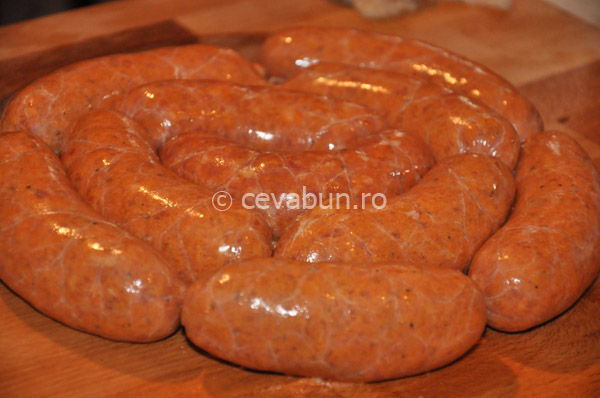
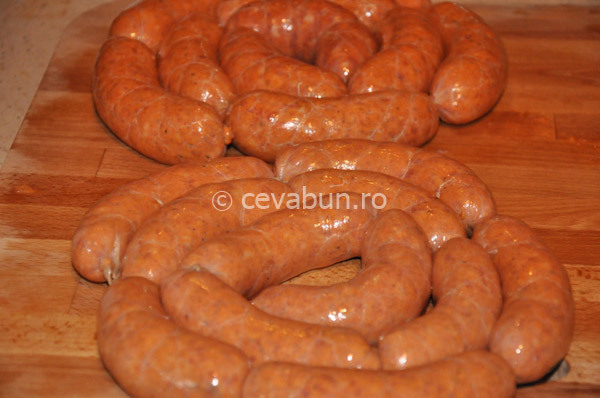
Cârnaţi de porc
Cârnaţii sunt creditaţi de unele surse ca fiind părinţii accidentali ai mititeilor româneşti. Fie că e sau nu adevărat, cârnaţii sunt pe gustul oamenilor de pretutindeni. Proaspeţi sau uscaţi, cruzi sau afumaţi, cârnaţii au marea calitate de a se lăsa aromaţi după priceperea şi gustul celui care îi face.
Cârnaţii de porc sunt ieftin de preparat, iar limita utilizării lor ulterioare este doar imaginaţia. Secretul cârnaţilor de porc constă în ingredientele de calitate, proporţiile corecte, maţele potrivite şi uscarea/afumarea lor corespunzătoare.
Există multe adaosuri în amestecul de carne de la nucsoara la coriandru şi de la ienibahar la ardei iute pisat, însă reţeta de bază rămâne cea de mai jos.
Porţii: 1.7  kilograme
Timp de preparare: 1 oră
Ingrediente:
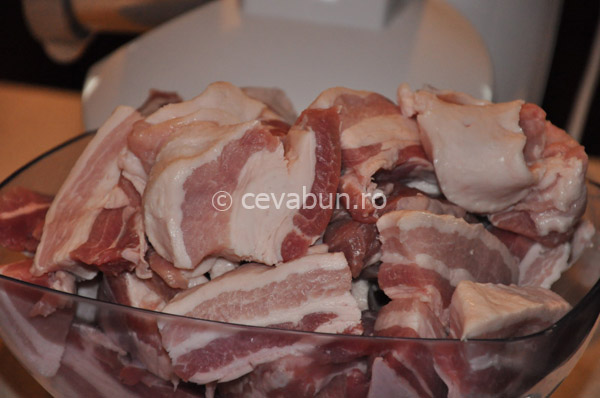
  • 1,5 kilograme carne de porc grasă
  • 2 metri maţe de porc
  • 40 de grame de usturoi
  • 30 de grame de sare
  • 8 grame de piper
  • 25 de grame de boia dulce
  • 250 ml supă de carne cu oase
  • 1 lingură de cimbru uscat (opţional)
Preparare:
Cea mai potrivită carne pentru cârnaţi este cea care abundă în ţesut gras (pulpă, burtă, ceafă, etc). Proporţia de grăsime carne este de de 50-50 la sută sau 60-40 la sută (60% carne). Prin scurgere, uscare şi afumare o parte din grăsimi se topește.
  1. Spălaţi bine maţele (intestinele de porc). Dacă sunt proaspete, eliminaţi-le surplusul de grăsime cu dosul unui cuţit. Dacă sunt în sare, desăraţi-le în apă rece. Verificaţi-le introducând (suflând) aer în ele pentru a depista eventualele imperfecţiuni (tăieturi, spărturi, etc).
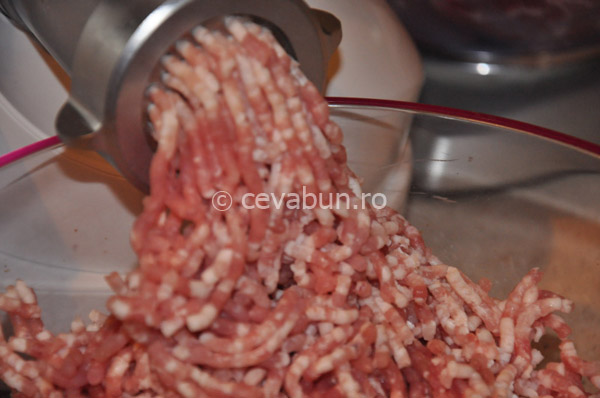
  2. Tocaţi carnea împreună cu grăsimea. Este important să nu fie tocate prea fin. Chiar dacă sunteţi nevoiţi să le tocaţi de două ori, carnea şi grăsimea trebuie să fie distincte.
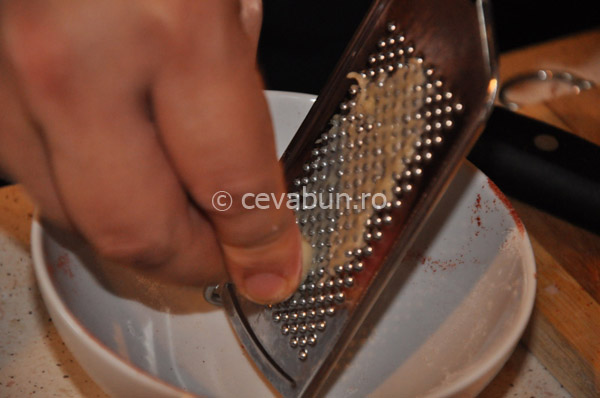
  3. Curăţaţi usturoiul şi pisaţi-l fin până obţineţi o pastă. Amestecaţi pasta obţinută cu 100 ml de supă de carne. Ideală este zeama în care au fiert piftiile deoarece conţine gelatină. Lăsaţi usturoiul în supă pentru minim 10 minute după care strecuraţi zeama printr-un tifon sau sită fină.
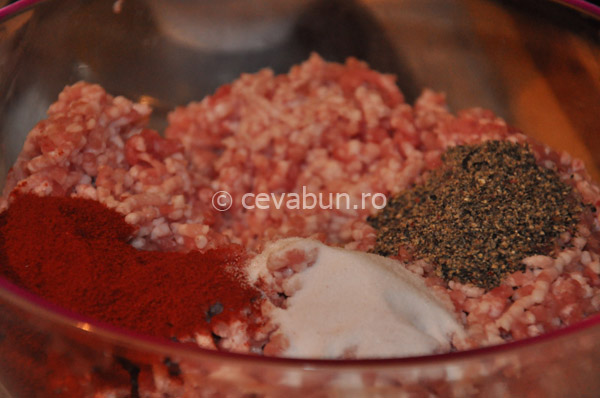
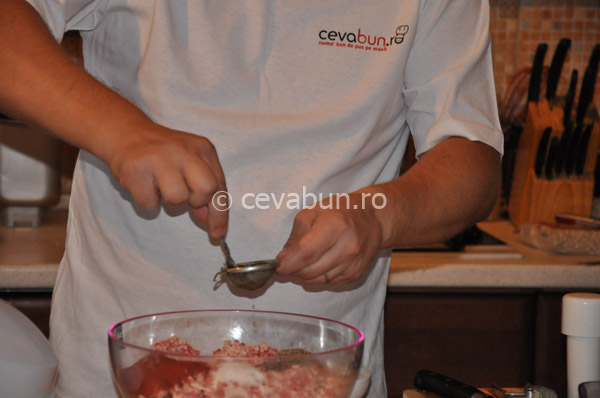
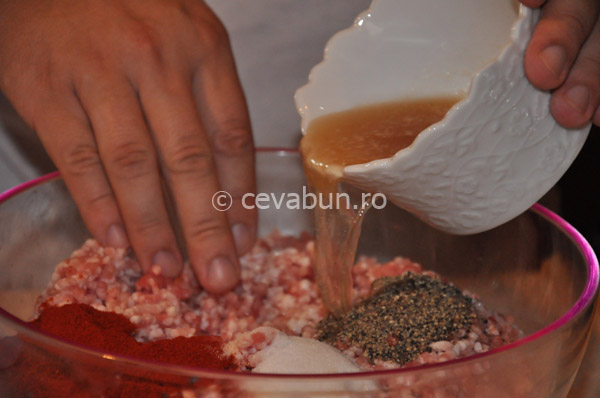
  4. Amestecaţi carnea cu sarea, piperul măcinat, boiaua de ardei , cimbrul şi zeama de carne cu usturoi.
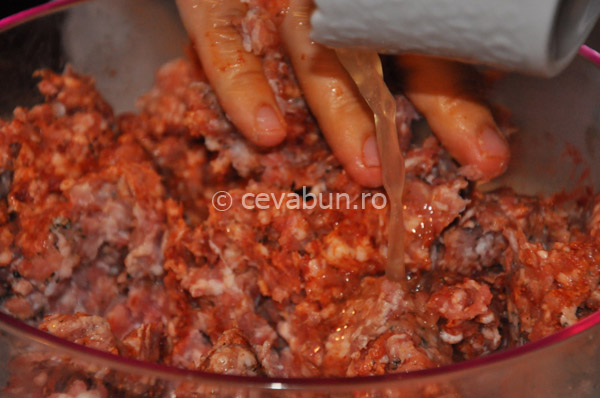
  5. Frământaţi amestecul până se omogenizează şi adăugaţi treptat zeamă de carne până amestecul devine maleabil.
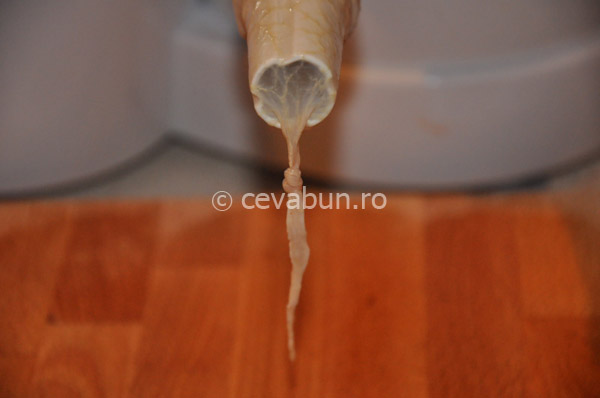
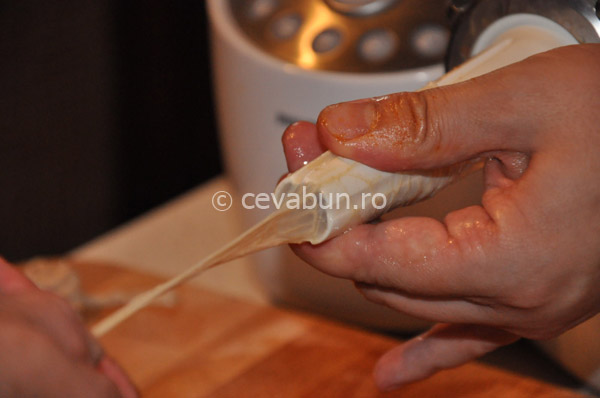
  6. Rulaţi intestinul de porc pe  dispozitivul conic, special, al maşinii de tocat carne (electrică sau mecanică).
  7. După ce tot intestinul a fost rulat pe dispozitivul pentru cârnaţi, faceți un nod în capătul acestuia.
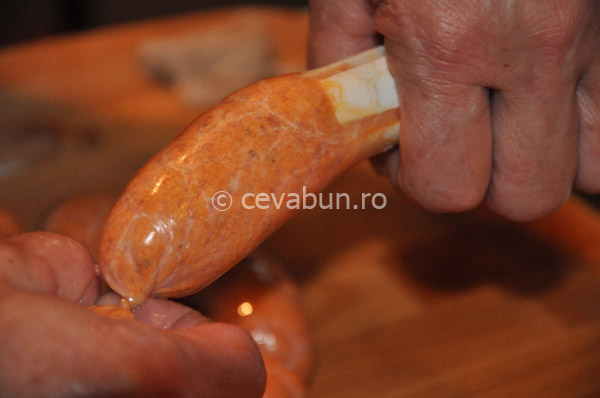
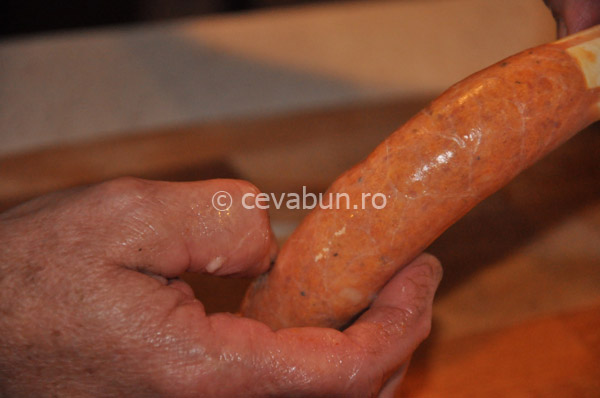
  8. Introduceţi carne în maşina de tocat şi umpleţi treptat intestinul de porc. Din loc în loc, cam la 20-25 de centimetri, răsuciţi intestinul de două-trei ori pentru a obţine cârnaţii (vezi galeria foto).
  9. Procedaţi în acest fel până când aţi finalizat tot amestecul. La ultimul cârnat, faceți din nou un nod la capăt.
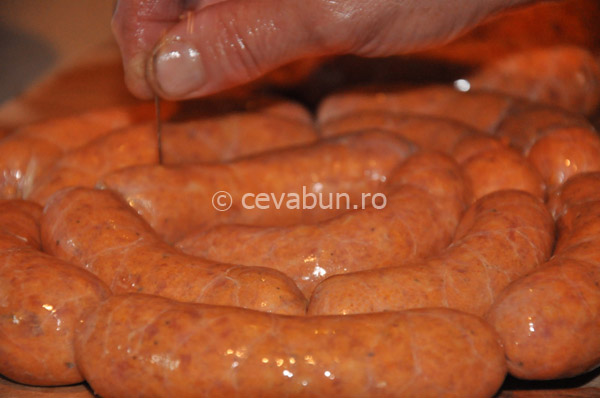
  10. Cu un ac de cusut împungeţi cârnaţii din loc în loc pentru a elimina golurile de aer şi a permite cârnaţilor să se zvânte.
  11. Pe o bucată de lemn sau o coadă de mătură acoperită cu o hârtie de pergament puneţi cârnaţi să se scurgă şi matureze peste noapte într-o cămară. Nu uitaţi să puneţi un vas sub ei pentru a prelua eventualele scurgeri de grăsime.
    Verificaţi pe unde umblă pisica şi dacă nu există riscul ca alte animale nedorite să atenteze la cârnaţii dumneavoastră.
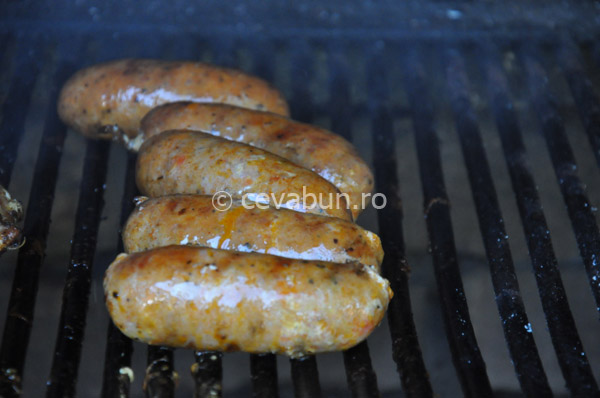
Cârnaţii se pot folosi a doua zi prăjiţi la grătar sau tigaie sau uscaţi/afumaţi mai multe zile.
Cea mai potrivită boia pentru cârnaţi este cea spaniolă, afumată, care va da chiar şi cârnaţilor proaspeţi o aroma naturală de fum.
Dacă doriţi cârnaţi mai aromaţi, puteţi adăuga în amestec 4-5 boabe de enibahar zdrobite şi o lingură de boabe de  coriandru pisate.
Dacă doriţi să afumaţi cârnaţii, faceţi-o cu fum rece – sursa de fum să se afle la o distanţă rezonabilă faţă de cârnaţi – obţinut din lemn fără răşini (adică fără lemn de conifere).


Carnati de casa ,costite si slanina afumata

Ingrediente:Pt carnati de casa

3kg Carne de porc ,macra 2kg si1kg carne mai grasa
usturoi pisat,coriandru,sare si piper ,putina boia dulce, 200ml supa de oase fierte si
mate subtiri
Preparare ;
1 Carnea o macinam cu masina de tocat ,sa pune apoi intr-un vas de plastic(nu metal ca sa nu se oxideze)
2Toate ingredientele se pun (pe rand) peste carnea tocata si se framanta bine, se adauga supa de oase si se framanta in continuare. Se mai potriveste de sare, piper daca mai e nevoie si se umple apoi cu carnatarul in intestine.
3Se inteapa pe alocuri cu un ac sa nu crape intestinul si se pun la zvantat la rece pana a doua zi
4A doua zi se pun carnatii la afumat in afumatoare
(in afumatoare eu ai tin cam 2 sau chiar si 3zile )
Pofta buna !!!!!


Caltabosi

Ingrediente:
1,500 kg ficat, inimă, plămini, splina, 1 kg carne rămasă de la fasonare sau de la ceafă, 300 g ceapa, 100 g orez, intestine groase, sare, piper pisat.

Mod de preparare:
Ficatul, inima, plaminii si splina se pun la fiert împreuna, iar carnea se pune la fiert separat. Ceapa se curata, se spala si se taie marunt, se inabusa in putina untura sau cu slănina proaspata, taiata marunt. Orezul se alege, se spala si se pune la fiert pina se umfla, apoi se scurge si se clateste cu apa rece. Carnea si organele, dupa ce au fiert si s-au racit, se trec prin masina de tocat carne, în pasta obtinuta se adauga orezul, ceapa inabusita bine (calita) si condimente dupa gust. Se amesteca bine componentele, obtinind o compozitie omogena, cu care se umple intestinul gros.

Umplerea caltobosilor. La masina de tocat carne se adauga un dispozitiv special, prevazut cu o pîlnie de umplut cirnati, care se gaseste in comert, adaptat la marimea (numarul) masinii de tocat. Se trece tot intestinul prin pilnie, lasindu-se capatul (legat cu o ata) putin afara. Umplerea se realizeaza lent, pentru a nu se indesa compozitia, legindu-se din loc in loc cu o sforicica, sau se umplu bucati de caltabosi mai scurte, de 20 - 30 cm. Caltabosii umpluti se pun la fiert in apa fierbinte si se fierb lent, fara sa clocoteasca, timp de 30 - 40 minute, in timpul fierberii se inteapa cu un ac gros in locurile umflate, pentru a nu plesni intestinul. In acelasi timp, odata cu intepatul se verifica şi starea de fierbere a continutului: daca sint fierti, iese din caltabos zeama albicioasa, iar daca zeama este roscata, inca nu sint suficient fierti si mai trebuie sa fiarba. Caltabosii fierti se scot intr-un vas cu apa rece, iar dupa racire, se pun pe o planseta pentru zvintat. Dupa aceasta operatie se pot afuma, cu fum rece. Se pastreaza la rece, se recomanda sa se serveasca ca gustari la mesele principale, cu mustar.

Caltabosii se pot prepara si din 100 g singe colectat igienic la un kg carne si cu inca 100 g orez, pus la fiert in aceeasi zeama in care a fiert carnea; compozitia se fierbe la foc lent, timp de 10 - 15 minute, amestecind tot timpul, ca sa nu se prinda orezul de vas. Cind este gata se lasa sa se raceasca si se umplu intestinele.

miercuri, 8 decembrie 2010

John Lennon

251 Menlove Avenue, the home of George and Mimi Smith, where Lennon lived for most of his childhood and adolescence
Lennon was born in war-time England, on 9 October 1940 at Liverpool Maternity Hospital, to Julia and Alfred Lennon, a merchant seaman who was away at the time of his son's birth.[1] John Lennon was named after his paternal grandfather, John "Jack" Lennon, and then-Prime Minister Winston Churchill.[2] His father was often away from home but sent regular pay cheques to 9 Newcastle Road, Liverpool, where Lennon lived with his mother,[3] but the cheques stopped when he went absent without leave in February 1944.[4][5] When he eventually came home six months later, he offered to look after the family, but Julia—by then pregnant with another man's child—rejected the idea.[6] After her sister, Mimi Smith, twice complained to Liverpool's Social Services, Julia handed the care of Lennon over to her. In July 1946, Lennon's father visited Smith and took his son to Blackpool, secretly intending to emigrate to New Zealand with him.[7] Julia followed them—with her partner at the time, 'Bobby' Dykins—and after a heated argument his father forced the five-year-old to choose between them. Lennon twice chose his father, but as his mother walked away, he began to cry and followed her.[8] It would be 20 years before he had contact with his father again.[9]
Throughout the rest of his childhood and adolescence, he lived with his aunt and uncle, Mimi and George Smith, at Mendips, 251 Menlove Avenue, Woolton, who had no children of their own.[10] His aunt bought him volumes of short stories, and his uncle, a dairyman at his family's farm, bought him a mouth organ and engaged him in solving crossword puzzles.[11] Julia visited Mendips on a regular basis, and when he was 11-years-old he often visited her at 1 Blomfield Road, Liverpool, where she played him Elvis Presley records, and taught him the banjo, playing "Ain't That a Shame" by Fats Domino.[12]
In September 1980 he talked about his family and his rebellious nature:
Part of me would like to be accepted by all facets of society and not be this loudmouthed lunatic musician. But I cannot be what I am not. Because of my attitude, all the other boys' parents ... instinctively recognised what I was, which was a troublemaker, meaning I did not conform and I would influence their kids, which I did. ... I did my best to disrupt every friend's home ... Partly, maybe, it was out of envy that I didn't have this so-called home, but I really did ... There were five women who were my family. Five strong, intelligent women. Five sisters. Those women were fantastic ... that was my first feminist education ... One happened to be my mother ... she just couldn't deal with life. She had a husband who ran away to sea and the war was on and she couldn't cope with me, and when I was four-and-a-half, I ended up living with her elder sister ... the fact that I wasn't with my parents made me see that parents are not gods.[13]
He regularly visited his cousin Stanley Parkes in Fleetwood. Seven years Lennon's senior, Parkes took him on trips, and to local cinemas.[11] During the school holidays, Parkes often visited Lennon with Leila Harvey, another cousin, often travelling to Blackpool two or three times a week to watch shows. They would visit the Blackpool Tower Circus and see artists such as Dickie Valentine, Arthur Askey, Max Bygraves and Joe Loss, with Parkes recalling that Lennon particularly liked George Formby.[14] After Parkes's family moved to Scotland, the three cousins often spent their school holidays together there. Parkes recalled, "John, cousin Leila and I were very close. From Edinburgh we would drive up to the family croft at Durness, which was from about the time John was nine years old until he was about 16."[15] He was 14-years-old when his uncle George died of a liver haemorrhage on 5 June 1955 (aged 52).[16]
Lennon was raised as an Anglican and attended Dovedale Primary School.[17] From September 1952 to 1957, after passing his Eleven-Plus exam, he attended Quarry Bank High School in Liverpool, and was described by Harvey at the time as, "A happy-go-lucky, good-humoured, easy going, lively lad."[18] He often drew comical cartoons which appeared in his own self-made school magazine called The Daily Howl,[19] but despite his artistic talent, his school reports were damning: "Certainly on the road to failure ... hopeless ... rather a clown in class ... wasting other pupils' time."[20]
His mother bought him his first guitar in 1957, an inexpensive Gallotone Champion acoustic for which she "lent" her son five pounds and ten shillings on the condition that the guitar be delivered to her own house, and not Mimi's, knowing well that her sister was not supportive of her son's musical aspirations.[21] As Mimi was sceptical of his claim that he would be famous one day, she hoped he would grow bored with music, often telling him, "The guitar's all very well, John, but you'll never make a living out of it".[22] On 15 July 1958, when Lennon was 17-years-old, his mother, walking home after visiting the Smiths' house, was struck by a car and killed.[23]
Lennon failed all his GCE O-level examinations, and was only accepted into the Liverpool College of Art after his aunt and headmaster intervened.[24] Once at the college, he started wearing Teddy Boy clothes and acquired a reputation for disrupting classes and ridiculing teachers. As a result, he was excluded from the painting class, then the graphic arts course, and was threatened with expulsion for his behaviour, which included sitting on a nude model's lap during a life drawing class.[25] He failed an annual exam, despite help from fellow student and future wife Cynthia Powell, and was "thrown out of the college before his final year."[26]

1957–70: From the Quarrymen to the Beatles

1957–65: Formation, commercial breakout, and touring years

Lennon playing with The Beatles in 1964 at the height of Beatlemania
The Beatles evolved from Lennon's first band, the Quarrymen. Named after Quarry Bank High School, the group was established by him in September 1956 when he was 15, and began as a skiffle group.[27] By the summer of 1957 the Quarrymen played a "spirited set of songs" made up of half skiffle, and half rock and roll.[28] Lennon first met Paul McCartney at the Quarrymen's second performance, held in Woolton on 6 July at the St. Peter's Church garden fête, after which McCartney was asked to join the band.[29] Lennon's Aunt Mimi disapproved of McCartney because he was, as she said, "working class",[30] with McCartney's father also disapproving, declaring that Lennon would get his son "into a lot of trouble";[31] although later allowing the fledgling band to rehearse in the McCartney's front room at 20 Forthlin Road.[32] Lennon was 18 when he wrote his first song ("Hello Little Girl", a UK top 10 hit for The Fourmost nearly five years later).[33]
Stuart Sutcliffe, Lennon's friend from art school, joined as bassist,[34] and George Harrison joined the band as lead guitarist.[35] Lennon, McCartney, Harrison and Sutcliffe became "The Beatles" in early 1960. In August of that year The Beatles, engaged for a 48-night residency in Hamburg, Germany, asked drummer Pete Best to join them one day before leaving.[36] Lennon was now 19, and his aunt, horrified when he told her about the trip, pleaded with him to continue his art studies instead.[37] After the first Hamburg residency, the band accepted another in April 1961, and a third in April 1962. Like the other band members, Lennon was introduced to Preludin while in Hamburg,[38] and regularly took the drug, as well as amphetamines, as a stimulant during their long, overnight performances.[39]
Brian Epstein, the Beatles' manager from 1962, had no prior experience of artist management, but nevertheless had a strong influence on their early dress code and attitude on stage.[40] Lennon initially resisted Epstein's attempts to encourage the band to present a professional appearance, but eventually complied, saying, "I'll wear a bloody balloon if somebody's going to pay me".[41] McCartney took over on bass after Sutcliffe decided to stay in Hamburg, and drummer Ringo Starr replaced Best, completing the four-piece line-up that would endure until the group's break-up in 1970. After discovering she was pregnant, Lennon married Powell on 23 August 1962, at the Mount Pleasant Register office in Liverpool.[42]
The band's first single, "Love Me Do", was released in October 1962 and reached #17 on the British charts. They recorded their debut album, Please Please Me, in under 10 hours on 11 February 1963—a day when Lennon was suffering the effects of a cold.[43] The Lennon/McCartney songwriting partnership yielded eight of its fourteen tracks. With few exceptions—one being the album title itself—Lennon had yet to bring his love of wordplay to bear on his song lyrics, saying: "We were just writing songs ... pop songs with no more thought of them than that–to create a sound. And the words were almost irrelevant".[44] In a 1987 interview, McCartney said that the other Beatles idolised John: "He was like our own little Elvis ... We all looked up to John. He was older and he was very much the leader; he was the quickest wit and the smartest".[45]
The Beatles achieved mainstream success in the UK around the start of 1963. Lennon was on tour when his first son, Julian, was born in April. During their Royal Variety Show performance, attended by the Queen Mother and other British royalty, Lennon poked fun at his audience: "For our next song, I'd like to ask for your help. For the people in the cheaper seats, clap your hands ... and the rest of you, if you'll just rattle your jewellery."[46] After a year of Beatlemania in the UK, the group's historic February 1964 US debut appearance on The Ed Sullivan Show marked their breakthrough to international stardom. A two-year period of constant touring, moviemaking, and songwriting followed, during which Lennon wrote two books, In His Own Write and A Spaniard in the Works.[47] The Beatles received recognition from the British Establishment when they were appointed Members of the Order of the British Empire in the Queen's Birthday Honours of 1965.[48]

1966–70: Studio years, break-up and solo beginnings

Lennon grew concerned that fans attending Beatles concerts were unable to hear the music above the screaming of fans, and that the band's musicianship was beginning to suffer as a result.[49] Lennon's "Help!" expressed his own feelings in 1965: "I meant it ... It was me singing 'help'".[50] He had put on weight (he would later refer to this as his "Fat Elvis" period),[51] and felt he was subconsciously seeking change.[52] The following January he was unknowingly introduced to LSD when a dentist, hosting a dinner party attended by Lennon, Harrison and their wives, spiked the guests' coffee with the drug.[53] When they wanted to leave, their host revealed what they had taken, and strongly advised them not to leave the house because of the likely effects. Later, in an elevator at a nightclub, they all believed it was on fire: "We were all screaming ... hot and hysterical."[53] A few months later in March, during an interview with Evening Standard reporter Maureen Cleave, Lennon remarked, "Christianity will go. It will vanish and shrink ... We're more popular than Jesus now—I don't know which will go first, rock and roll or Christianity."[54] The comment went virtually unnoticed in England but caused great offence in the US when quoted by a magazine there five months later. The furore that followed—burning of Beatles records, Ku Klux Klan activity, and threats against Lennon—contributed to the band's decision to stop touring.[55]
Deprived of the routine of live performances after their final commercial concert in 1966, Lennon felt lost and considered leaving the band.[56] Since his involuntary introduction to LSD in January, he had made increasing use of the drug, and was almost constantly under its influence for much of the year."[57] According to biographer Ian MacDonald, Lennon's continuous experience with LSD during the year brought him "close to erasing his identity".[58] 1967 saw the release of "Strawberry Fields Forever", hailed by Time magazine for its "astonishing inventiveness",[59] and the group's landmark album Sgt. Pepper's Lonely Hearts Club Band, which revealed Lennon's lyrics contrasting strongly with the simple love songs of the Lennon/McCartney's early years.
In August, after having been introduced to the Maharishi Mahesh Yogi, the group attended a weekend of personal instruction at his Transcendental Meditation seminar in Bangor, Wales.[60] The group were informed of the sudden death of Epstein during the seminar. "I knew we were in trouble then", Lennon said later. "I didn't have any misconceptions about our ability to do anything other than play music, and I was scared".[61] They later travelled to Maharishi's ashram in India for further guidance, and while there composed most of the songs for The Beatles and Abbey Road.[62]
The anti-war, black comedy How I Won the War, featuring Lennon's only appearance in a non–Beatles full-length film, was shown in cinemas in October 1967.[63] McCartney organised the group's first post-Epstein project,[64] the self written, produced and directed television film Magical Mystery Tour, released in December that year. Whilst the film itself proved to be their first critical flop, its soundtrack release, featuring Lennon's acclaimed, Carroll-inspired "I am the Walrus", was a success.[65][66] With Epstein gone, the band members became increasingly involved in business activities, and in February 1968 they formed Apple Corps, a multimedia corporation comprising Apple Records and several other subsidiary companies. Lennon described the venture as an attempt to achieve, "artistic freedom within a business structure",[67] but his increased drug experimentation and growing preoccupation with Yoko Ono, and McCartney's own marriage plans, left Apple in need of professional management. Lennon asked Lord Beeching to take on the role, but he declined, advising Lennon to go back to making records. Lennon approached Allen Klein, who had managed The Rolling Stones and other bands during the British Invasion. Klein was appointed as Apple’s chief executive by Lennon, Harrison and Starr, but McCartney refused to sign the management contract.[68]


At the end of 1968, Lennon featured in the film The Rolling Stones Rock and Roll Circus (not released until 1996) in the role of a Dirty Mac band member. The supergroup, comprising Lennon, Eric Clapton, Keith Richards and Mitch Mitchell, also backed a vocal performance by Ono in the film.[70] Lennon and Ono were married on 20 March 1969, and soon released a series of 14 lithographs called "Bag One" depicting scenes from their honeymoon,[71] eight of which were deemed indecent and most of which were banned and confiscated.[72] Lennon's creative focus continued to move beyond the Beatles and between 1968 and 1969 he and Ono recorded three albums of experimental music together: Unfinished Music No.1: Two Virgins[73] (known more for its cover than for its music), Unfinished Music No.2: Life with the Lions and Wedding Album. In 1969 they formed The Plastic Ono Band, releasing Live Peace in Toronto 1969. In protest at Britain's involvement in the Nigerian Civil War,[74] Lennon returned his MBE medal to the Queen, though this had no effect on his MBE status, which could not be renounced.[75] Between 1969 and 1970 Lennon released the singles "Give Peace a Chance" (widely adopted as an anti-Vietnam-War anthem in 1969),[76] "Cold Turkey" (documenting his withdrawal symptoms after he became addicted to heroin[77]) and "Instant Karma!".
Lennon left the Beatles in September 1969.[78] He agreed not to inform the media while the band renegotiated their recording contract, and was outraged that McCartney publicised his own departure on releasing his debut solo album in April 1970. Lennon's reaction was, "Jesus Christ! He gets all the credit for it!"[79] He later wrote, "I started the band. I disbanded it. It's as simple as that."[80] In later interviews with Rolling Stone, he revealed his bitterness towards McCartney, saying, "I was a fool not to do what Paul did, which was use it to sell a record."[81] He spoke too of the hostility he perceived the other members had towards Ono, and of how he, Harrison, and Starr "got fed up with being sidemen for Paul ... After Brian Epstein died we collapsed. Paul took over and supposedly led us. But what is leading us when we went round in circles?"[82]

1970–80: Solo career

1970–72: Initial post-Beatles years

Following the Beatles' break-up in 1970, Lennon and Ono went through primal therapy with Dr. Arthur Janov in Los Angeles, California. Designed to release emotional pain from early childhood, the therapy entailed two half-days a week with Janov for four months; he had wanted to treat the couple for longer, but they felt no need to continue and returned to London.[83] Lennon's emotional debut solo album, John Lennon/Plastic Ono Band (1970), was received with high praise. Critic Greil Marcus remarked, "John's singing in the last verse of 'God' may be the finest in all of rock."[84] The album spawned the singles "Mother", in which Lennon confronted his feelings of childhood rejection,[85] and the Dylanesque "Working Class Hero", a bitter attack against the bourgeois social system which, due to the lyric "you're still fucking peasants", fell foul of broadcasters.[86][87] The same year, Tariq Ali's revolutionary political views, expressed when he interviewed Lennon, inspired the singer to write "Power to the People". Lennon also became involved with Ali during a protest against Oz magazine's prosecution for alleged obscenity. Lennon denounced the proceedings as "disgusting fascism", and he and Ono (as Elastic Oz Band) released the single "God Save Us/Do the Oz" and joined marches in support of the magazine.[88]


With Lennon's next album, Imagine (1971), critical response was more guarded. Rolling Stone reported that "it contains a substantial portion of good music" but warned of the possibility that "his posturings will soon seem not merely dull but irrelevant".[91] The album's title track would become an anthem for anti-war movements,[92] while another, "How Do You Sleep?", was a musical attack on McCartney in response to lyrics from Ram that Lennon felt, and McCartney later confirmed,[93] were directed at him and Ono. However, Lennon softened his stance in the mid-70s and said he had written "How Do You Sleep?" about himself.[94] He said in 1980: "I used my resentment against Paul ... to create a song ... not a terrible vicious horrible vendetta ... I used my resentment and withdrawing from Paul and the Beatles, and the relationship with Paul, to write 'How Do You Sleep'. I don't really go 'round with those thoughts in my head all the time".[95]
Lennon and Ono moved to New York in August 1971, and in December released "Happy Xmas (War Is Over)".[96] To advertise the single, they paid for billboards in 12 cities around the world which declared, in the national language, "WAR IS OVER—IF YOU WANT IT".[97] The new year saw the Nixon Administration take what it called a "strategic counter-measure" against Lennon's anti-war propaganda, embarking on what would be a four-year attempt to deport him: embroiled in a continuing legal battle, he was denied permanent residency in the US until 1976.[98]
Recorded as a collaboration with Ono and with backing from the New York band Elephant's Memory, Some Time in New York City was released in 1972. Containing songs about women's rights, race relations, Britain's role in Northern Ireland, and Lennon's problems obtaining a green card,[99] the album was poorly received—unlistenable, according to one critic.[100] "Woman Is the Nigger of the World", released as a US single from the album the same year, was televised on 11 May, on The Dick Cavett Show. Many radio stations refused to broadcast the song because of the word "nigger".[101] Lennon and Ono gave two benefit concerts with Elephant's Memory and guests in New York in aid of patients at the Willowbrook State School mental facility.[102] Staged at Madison Square Garden on 30 August 1972, they were his last full-length concert appearances.[103]

1973–80: Lost and found

While Lennon was recording Mind Games (1973), he and Ono decided to separate. The ensuing eighteen-month period apart, which he later called his "lost weekend",[104] was spent in Los Angeles and New York in the company of May Pang. Mind Games, credited to "the Plastic U.F.Ono Band", was released in November 1973. More positively received than its predecessor, the album was critically assessed as "listenable" but "his worst writing yet" and found Lennon to be "helplessly trying to impose his own gargantuan ego upon an audience ... waiting hopefully for him to chart a new course"[100]. Its title track, "Mind Games", was a top 20 hit in the US and reached number 26 in the UK. Lennon contributed a revamped version of "I'm the Greatest", a song he wrote two years earlier, to Starr's album Ringo (1973), released the same month. (Lennon's 1971 demo appears on John Lennon Anthology.) During 1974 he produced Harry Nilsson's Pussy Cats and the Mick Jagger song "Too Many Cooks (Spoil the Soup)". The latter was destined, for contractual reasons, to remain unreleased for more than thirty years. Pang supplied the recording for its eventual inclusion on The Very Best of Mick Jagger (2007).[105]
Walls and Bridges (1974) yielded Lennon's only number one single in his lifetime, "Whatever Gets You Thru the Night", featuring Elton John on backing vocals and piano.[106] A second single from the album, "#9 Dream", followed before the end of the year. Starr's Goodnight Vienna (1974) again saw assistance from Lennon, who wrote the title track and played piano.[107] On 28 November, Lennon made a surprise guest appearance at Elton John's Thanksgiving concert at Madison Square Garden, in fulfilment of his promise to join the singer in a live show if "Whatever Gets You Thru the Night", a song whose commercial potential Lennon had doubted, reached number one. Lennon performed the song along with "Lucy in the Sky with Diamonds" and "I Saw Her Standing There".[108]
Lennon co-wrote "Fame", David Bowie's first US number one, and provided guitar and backing vocals for the January 1975 recording.[109] He and Ono were reunited shortly afterwards.[110] The same month, Elton John topped the charts with his own cover of "Lucy in the Sky with Diamonds", featuring Lennon on guitar and back-up vocals. Lennon released Rock 'n' Roll (1975), an album of cover songs, in February. Soon afterwards, "Stand By Me", taken from the album and a US and UK hit, became his last single for five years. He made what would be his final stage appearance in the ATV special A Salute to Lew Grade, recorded on 18 April and televised in June.[111] Playing acoustic guitar, and backed by his eight-piece band BOMF (introduced as "Etcetera"), Lennon performed two songs from Rock 'n' Roll ("Slippin' and Slidin'" and "Stand By Me", the latter of which was excluded from the television broadcast) followed by "Imagine".[111] The band wore masks on the backs of their heads, making them appear two-faced, a dig at Grade,[112] with whom Lennon and McCartney had been in conflict because of his control of the Beatles' publishing company. (Dick James had sold his majority share to Grade in 1969.) During "Imagine", Lennon interjected the line "and no immigration too", a reference to his battle to remain in the United States.[99]
When Lennon's second son, Sean, was born on 9 October 1975, he took on the role of househusband, beginning what would be a five-year hiatus from the music industry during which he gave all his attention to his family.[13] Within the month, he fulfilled his contractual obligation to EMI/Capitol for one more album by releasing Shaved Fish, a compilation album of previously recorded tracks. He devoted himself to Sean, rising at 6 am daily to plan and prepare his meals and to spend time with him.[113] He wrote "Cookin' (In the Kitchen of Love)" for Starr's Ringo's Rotogravure (1976), performing on the track in June in what would be his last recording session until 1980.[114] He formally announced his break from music in Tokyo in 1977, saying, "we have basically decided, without any great decision, to be with our baby as much as we can until we feel we can take time off to indulge ourselves in creating things outside of the family."[115] During his career break he created several series of drawings, and drafted a book containing a mix of autobiographical material and what he termed "mad stuff",[116] all of which would be published posthumously.
He emerged from retirement in October 1980 with the single "(Just Like) Starting Over", followed the next month by the album that spawned it. Double Fantasy contained songs, written during a journey to Bermuda on a 43-foot sailing boat the previous June,[117] that reflected Lennon's fulfillment in his new-found stable family life.[118] The album took its title from a species of freesia, seen in the Bermuda Botanical Gardens, whose name Lennon regarded as a perfect description of his marriage to Ono.[119] Sufficient additional material was recorded for a planned follow-up album Milk and Honey (released posthumously in 1984).[120] Released jointly with Ono, Double Fantasy was not well received, drawing comments such as Melody Maker's "indulgent sterility ... a godawful yawn".[121]

December 1980: Murder

Strawberry Fields Memorial to John Lennon in Central Park, New York
At around 10:50 pm on 8 December 1980, as Lennon and Ono returned to their New York apartment in The Dakota, Mark David Chapman shot Lennon in the back four times at the entrance to the building. Lennon was taken to the emergency room of nearby Roosevelt Hospital and was pronounced dead on arrival at 11:07 pm.[122] Earlier that evening, Lennon had autographed a copy of Double Fantasy for Chapman.[123]
Ono issued a statement the next day, saying "There is no funeral for John," ending it with the words, "John loved and prayed for the human race. Please pray the same for him."[124] His body was cremated at Ferncliff Cemetery in Hartsdale, New York. Ono scattered his ashes in New York's Central Park, where the Strawberry Fields memorial was later created.[125] Chapman pleaded guilty to second degree murder and was sentenced to 20 years to life; as of 2010, he remains in prison, having been repeatedly denied parole.[

marți, 7 decembrie 2010

"WikiLeaks", mai pervers decât "guru"

 
Fondatorul Wikileaks a ajuns ieri acolo unde şi-o doreau mulţi din cei afectaţi de dezvăluirile pe care le-a publicat: pe mâinile poliţiei. Şi asta după ce justiţia suedeză a dat ascultare acuzaţiilor destul de ciudate formulate de două femei a căror activitate pune destule semne de întrebare asupra veridicităţii faptelor de care se plâng. Aceeaşi justiţie suedeză care a emis un mandat de arestare pe numele lui Julian Assange pentru "sex pe nepregătite", i-a acordat azil politic liderului MISA, Gregorian Bivolaru, pe când era cercetat în România, printre altele, pentru perversiune sexuală, act sexual cu un minor, trafic de minori.

Dacă săptămâna trecută l-a acuzat pe fondatorul WikiLeaks de "sex pe nepregătite", justiţia suedeză a revenit, susţinând că, de fapt, declaraţiile uneia dintre femei au fost prost redactate.

"Sex pe nepregătite" sau "prin surprindere" a fost acuzaţia care a dat mari bătăi de cap jurnaliştilor din întreaga lume, dar şi avocatului fondatorului WikiLeaks, care a declarat că nu ştie ce se poate înţelege prin această infracţiune care îi fusese adusă la cunoştinţă de autorităţile suedeze. Se pare însă că infracţiunea de "suprindere" sexuală a fost provocată de un prezervativ care s-a rupt. În ciuda acestui fapt, fondatorul WikiLeaks a continuat actul sexual. În mod normal, pentru "sex pe neprăgătite", legea suedeză îl amendează pe vinovat cu 5.000 de coroane (aproximativ 715 dolari).

Însă atunci când s-a prezentat la un comisariat al poliţiei londoneze, Julian Assange, pe numele căruia fusese emis un mandat internaţional de căutare, a fost arestat şi a aflat că trebuie să răspundă la patru capete de acuzare: unul pentru constrângere, două pentru violenţe sexuale şi una pentru viol. Acuzaţiile sunt susţinute de două femei suedeze, iar faptele ar fi fost comise în august, anul acesta, în timpul unei vizite în Suedia.

La 20 august, suedezele ar fi depus plângeri la poliţie împotriva lui Assange, pe care-l acuzau de viol şi agresiune sexuală. Într-o notă adresată cotidianului suedez Dagens Nyheter, fondatorul WikiLeaks a dezminţit acuzaţiile, afirmând că nu a fost contactat de poliţie, şi că la 21 august a fost exonerat de procuratură. Assange era deja cunoscut la acea vreme, pentru că făcuse publică o înregistrare secretă a unui atac american, de la Bagdad, în urma căruia mai mulţi civili fuseseră omorâţi. Una dintre femeile care îl acuză pe Assange se pare că este Anna Ardin, o militantă feministă controversată. Aceasta s-a făcut cunoscută mai ales datorită unui manual despre cum pot femeile să se răzbune legal sau să saboteze în şapte etape o relaţie sexuală. Cealaltă suedeză susţine că faptele s-au petrecut în timpul partidei de sex în trei în care, susţin diverse publicaţii internaţionale, ar fi fost implicată cu Assange şi, se pare, cu Anna Ardin.

Assange spune că a fost vorba de sex consensual, că acuzaţiile femeilor sunt false şi că reprezintă prima lovitură sub centură la care se aştepta de la cei deranjaţi de dezvăluirile sale.

Dură cu Assange, justiţia suedeză a fost deosebit de înţelegătoare cu "guru" Bivolaru. Suedia ne-a zis "pas" atunci când România i-a cerut, în 2005, să-l extrădeze pe "guru". Iar acesta nu era nici pe departe acuzat de "sex prin suprindere", ci de perversiune sexuală, act sexual cu un minor, trafic de minori, trafic de persoane şi trecere frauduloasă a frontierei de stat. Orgiile lui Bivolaru i-au adus acestuia din partea Suediei decât... protecţie, adică azil politic.